Installations & Objects


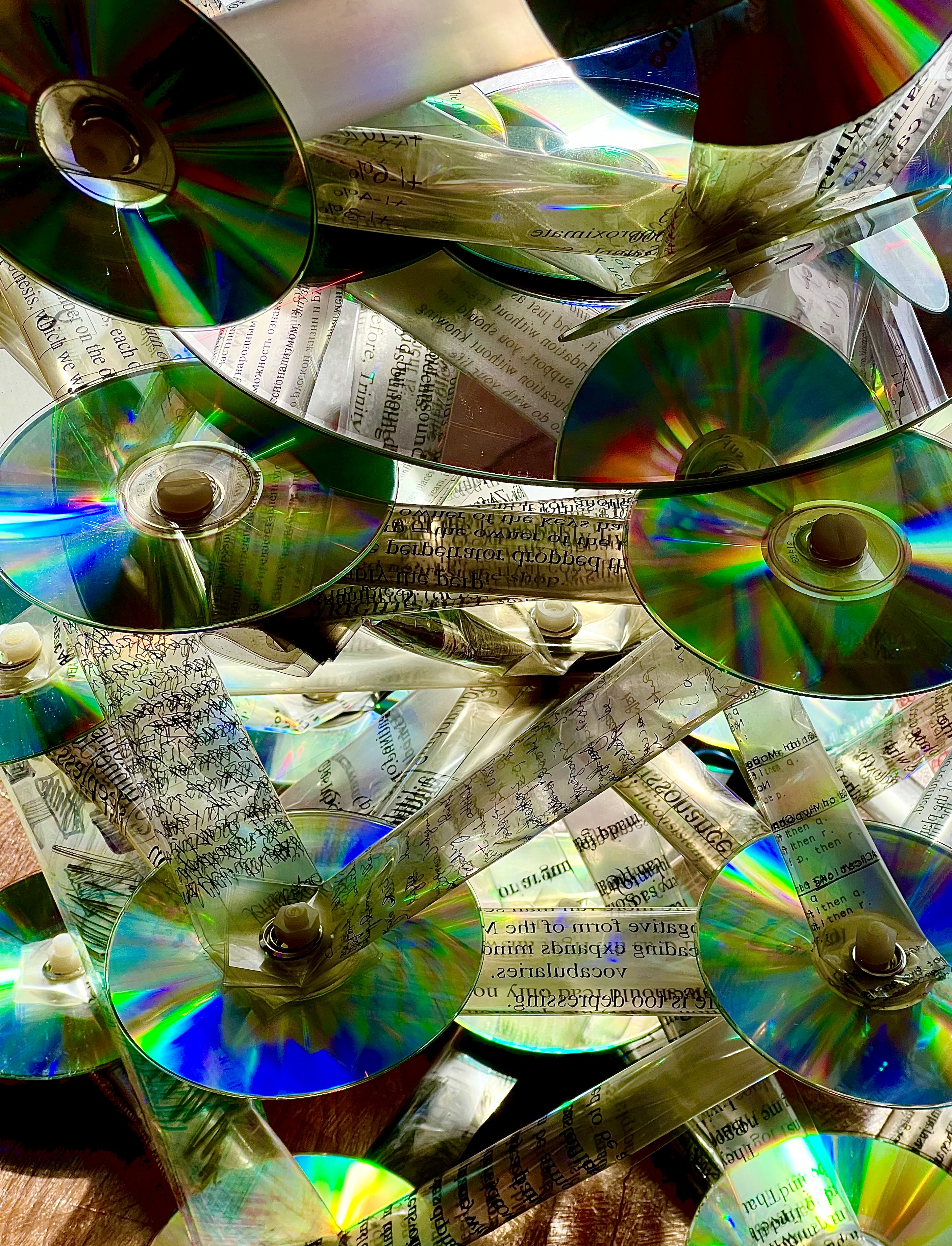
T.O.E. (The Theory of Everything) freezes time in two directions.
Read from the top down, it describes causality. Each event is a shiny disk, and from each spring at least two more — consequences of the first — and from these spring at least two more. (Humans tend to think of single causes as having single effects. This is not how the world works.)
Read from the bottom up, it describes perception, which begins with a welter of events, a tumult of sensation, which is slowly refined into a single percept or story. (Humans tend to forget or overlook the details; the world does not.)
The struts of T.O.E. are rolled-up overhead projector transparencies from several decades of college teaching — artifacts of the good old overhead projector. The disks are data CD-ROMs bearing brain scan data from hundreds of subjects, which informed decades of analyses of brain and consciousness. In short, T.O.E. is also autobiographical.