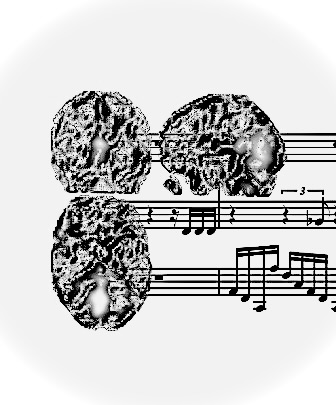
Music
…or maybe it’s all… music. Along with tool use and language, music is another marker of our humanness. Every culture sings, plays, and dances, and humans have been doing it for a very long time: we have bone flutes more than 40,000 years old. (That’s five times more ancient than the first domestic crops, writing, organized villages….) Music exhibits common features across all cultures, despite huge variation in the details. And music is very different from spoken or written language.
Back in the 20th Century, one well-known hypothesis claimed that the mind/brain used a special “language of thought” for its internal communication. This idea fit nicely with the conjecture that the brain was a biological computer; as such, it would have its own programming language. Thus, the language metaphor offered a way of thinking and describing mind/brain function. The other available metaphor, however, is music. Musicologists, especially cognitive musicologists, deploy a rich language to describe their very rich subject. I suggest that their lexicon be applied in our study of the dynamic brain.
For the details, look at the overlap of Mind and Music. Or listen in to the brain itself, via the brainmusic playlist on YouTube.