What makes human consciousness distinct from everything else, including AI, is our awareness of time. We directly confront the now, but with an omnipresent awareness of the immediate past, and anticipation of the immediate future.
๐
Book
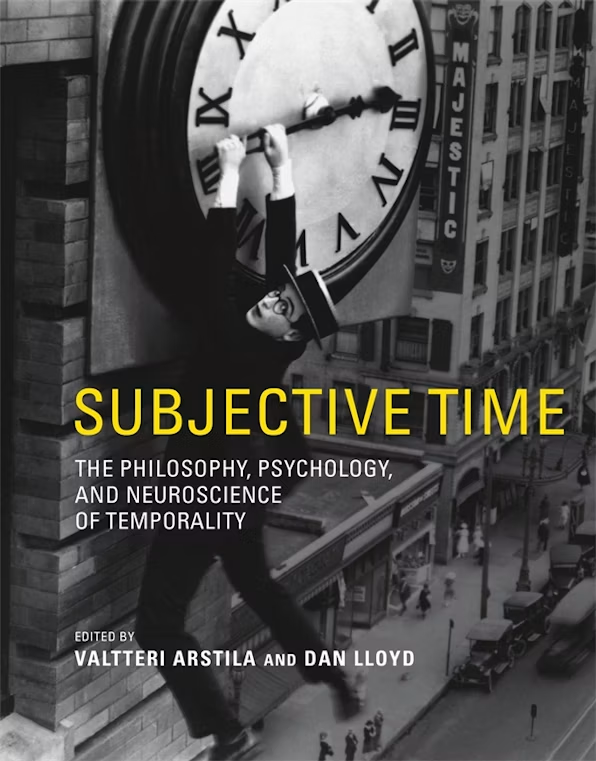
Subjective Time
MIT Press, 2014 ยท Co-edited with Valtteri Arstila ยท MIT Press โ
The flagship here is a collaboration with the Finnish philosopher (and friend) Valtteri Arstila. The book collects articles by philosophers, psychologists, and neuroscientists, all swirling about the central mystery: We directly confront the now, but with an omnipresent awareness of the immediate past, and anticipation of the immediate future. (This, I conjecture, is disrupted by psychiatric illnesses, drugs, and other forces.)
๐
Papers
2024
Dynamic Snapshots and Artificial Temporality
Do AI systems have any purchase on time โ on the flow of experience from past through present to anticipated future? An exploration of what temporal structure in neural networks can and cannot simulate.
In True Colors, Time After Time, Painosalama Oy, 2024PDF โ
2012
Time After Time: Temporality in the Dynamic Brain
On the layered structure of conscious time โ the specious present, retention, and protention โ and what neuroimaging can reveal about how the brain sustains this temporal arc.
In Being in Time, Edelman, Fekete & Zach, eds. John Benjamins, 2012, pp. 1โ21PDF โ
2012
Neural Correlates of Temporality: Default Mode Variability and Temporal Awareness
An investigation of how spontaneous fluctuations in default mode network activity relate to the brain's construction of temporal awareness โ linking resting-state variability to the felt passage of time.
Consciousness and Cognition, 21:695โ703, 2012doi โ
2012
Schizophrenia and Functional Imaging: Shame of the City
An examination of what neuroimaging studies of schizophrenia reveal โ and conceal โ about the disorder's disruption of temporal and cognitive integration in the brain.
On schizophrenia as a disorder of temporal self-awareness โ and what that implies for how we understand both the illness and the structure of normal conscious experience.
Functional MRI and the Study of Human Consciousness
A secondary analysis of four fMRI datasets applying phenomenological concepts โ intentionality, superposition, and temporality โ to the study of consciousness. Multivariate methods reveal neural analogues of temporal structure across 27 subjects.
Journal of Cognitive Neuroscience, 14(6):818โ831, 2002PDF โ
2014
The Disunity of Time
A closing reflection on the experimental psychology of time perception โ arguing that subjective time is not one thing but many, built from dissociable mechanisms and embedded in the fabric of perception and action.
With Valtteri Arstila, in Subjective Time, MIT Press, 2014