Topic
Shakespeare
I came down with bardophilia as a first year student at Oberlin, and have displayed symptoms of idolatry ever since — including a course at Trinity, "Shakespeare as Philosopher." This is also a book in progress.
I came down with bardophilia as a first year student at Oberlin, and have displayed symptoms of idolatry ever since — including a course at Trinity, "Shakespeare as Philosopher." This is also a book in progress.
When in London, I always try to catch the current shows at "Shakespeare's Globe," the replica of the original Globe theater that burned some 400 years ago. I'm usually among the groundlings, and I try to arrive early so I can prop myself right at the stage edge -- not necessarily the best view but good for hearing, over the passing helicopters and sirens. On a very hot day in 2017 I heard Romeo and Juliet from my spot, exactly at the front corner of the stage, by the stair that actors could take to exit through the crowd. Juliet and Romeo were just there, taking their leave near the bottom stair, concluding the second balcony scene. As we know but they can only fear, they will never speak to each other again.
At that, Romeo waded into the audience and on to Mantua. Bereft Juliet watched from the stair. On that day, at that moment, as she let fall the hand that just held Romeo's, Juliet turned to me, grabbed my arm in both hands, and looked mysteriously and meaningfully into my eyes. I stammered something -- I believe it was "Don't worry, it'll be OK" -- what a timid person might say notwithstanding that his auditor was doomed. She turned away and reascended to the stage and the ensuing tragedy.
Who were these two beings, enmeshed for one memorable second in the Globe? For me, the experience and its best description lists the personnel as: Juliet Capulet, Dan Lloyd. In my impulse (and on reflection), I was speaking not to an actor but to Juliet herself. Romeo and Juliet are star-crossed, but Dan and Juliet have it worse, being from different dimensions. The encounter was impossible, on the To Do Never list after tea with Sherlock Holmes or shuffleboard on the deck of the Pequod. Yet in my mind the living, breathing person clutching me was Juliet.
This book is an exploration and ultimately a vindication of the intuition that Juliet from the play world created by Shakespeare, and me, from the "real world," ultimately come from one shared reality, a place where the play world and the real world coincide. This metaphysical magic, I believe, was always on Shakespeare's mind, and his toolbox comprised several methods of realizing it. When the magic is full engaged, we in the live audience experience a kind of double vision of the characters on stage, the stage itself, and ourselves. In those moments we see self-same objects and people as belonging to two incommensurate worlds at once.
It's a special effect, but not mere flourish. Rather, the double vision affords a theatrical boost to the emotional impact of the drama. Moreover, its aesthetic power adapts itself to a variety of thematic ideas. The broad spectrum of Shakespearean drama is enhanced by several variations on this pairing of theme and technique. Tracking these variations and their effects is one of the tasks set on this book. As such, it's an exercise in literary studies.
How could it be more than that? Many of you will dismiss my brief affair with Juliet Capulet. I was deceived by *, the accomplished actor, into supposing her to be Juliet; even at the time I knew better. A bit of figurative language and my imagination, not some metaphysical clap-trap, is the only take-away here. This is how we modern folk see things: reality is the sealed circuit of objects ultimately described by the sciences. And then there is the representation of that reality. Representations may be true or false, their contents real or unreal; Romeo and Juliet are unreal. There are not two houses alike in dignity in fair Verona, nor are there two houses unlike in dignity. Rather, there are no houses at all. The double vision I've described is an exaggerated misreading of a purely theatrical device, like claiming ghosts are real on the evidence presented in Hamlet.
The response to that plausible skepticism sets a steeper task, to articulate and defend a vision of reality in which the fictive and real coexist on some common ground. Making that idea more than merely metaphorical is a philosophical task. It has its antecedents, in the idealism of Berkeley and its variations in Whitehead or Bradley, or the irrealism of Meinong. But, Shakespeare? Could he have entertained the idea that Juliet and some mere groundling could literally mingle? Could this notion be more than poetic license, an idea that he entertained, tested, and defended? These questions explore the possibilities of Shakespeare -- as philosopher.
In its briefest compass, in the pages ahead I'll identify a set of worries that found deep and convincing resonance in Shakespeare's poetry, especially the Sonnets. Responding to these worries motivated a distinctly Shakespearean view of reality, an outlook neither Medieval nor modern, a view explored through an expanding spectrum of plays. The view is tested through a kaleidoscope of thought experiments, also known as plays. Issues, implications, extensions, and roadblocks all take their turns. In the end, I propose that William Shakespeare, preeminent among poets and playwrights, will emerge as a lively colleague in the pantheon of philosophers as well.
The goal of all drama is to get us, the audience, to care what happens to characters on stage. To care we must see the world as the character sees it -- we must adopt their standpoint. A playwright's goal, then, will be spread through two strategies: to intensify our care for a main character while also enlarging the number of characters we care for. Standpoints must be deepened in detail and vividness, and multiplied across the stage.
Several walls stand in the way:
Playwrights (and creators of other art) spend their careers pushing on these boundaries. In general they pick their fights. Modern drama tends to mix fewer characters together, and deepen identification with some or all of them. Modern conceptions of realism assume an unbreached fourth wall. Some modern playwrights, however, seek a different kind of actuality, calling attention to the theatrical situation and the artifice of drama. In general, however, for most authors to breach one wall is to fortify another.
Shakespeare pushed hard on all three walls. Moreover, Shakespeare discovered techniques that overcame the three limits at once, in one fortunate swoop. The principal result is a raft of plays that continue to draw audiences in, achieving still what he needed then, namely, the steady success of his fellow players, their company, and their theater.
[He was at once a player and author, but not only that. In his spare time (somehow) he was a voracious and attentive reader. The study of any of the plays or poems usually reveals an array of sources, which he transfigured at every scale, from broad plot points to single apt phrases. Often the homage is so close that we imagine his Holinshed or Montaigne lying open on his writing desk.]
Depth, breadth, actuality.
Of the three boundaries I conjecture that the wall Shakespeare most wanted to breach is the second, the limit to the extent of our empathy, our tendency to align our identification with those who seem most like ourselves. Shakespeare, I believe, found himself continuously fascinated with The Other, that abstract title for anyone who is different from oneself. Shakespearean Others are a wonderful pantheon of types, each unique and almost all very revealed in their words and deeds. Accordingly, they are variable magnets of empathy. Their display of character and motivation incline us toward identification with them, but Shakespeare wanted more.
To pull us in, he performs some unique theatrical sleight of hand. An ontological trick, which (for want of a better term) I'll call ontological doubling, a form of reframing our perception. Reframing draws attention to aspects of the play world from the point of view of a character, aspects that are literally shared with the real world inhabited by us, the audience. When the trick works, we are more inclined to see the world the character's way because we recognize it as our world. The trick creates a continuity between the play world and the real world, and breaches the three barriers at once: The richness of the world is harnessed as something the character knows and the audience knows it -- added depth of characterization. It adds breadth by pulling us toward characters we might not otherwise identify with. We see their worlds. And it adds actuality... by being actual.
Here are some examples, beginning with the most familiar: The stage metaphor. Shakespeare was loath to repeat himself across plays, except for a few ideas that we encounter repeatedly. The melancholy Jaques in AYLI owns the most famous statement of one of them:
For Jaques this is a metaphor (no plays are performed in the Forest of Arden, though it is certainly dense with theatrical gestures). For us it is a metaphor as well, applicable to exactly the same extent to us as to him.
But to note that all the world's a stage while standing on a stage produces a second level of meaning. In addition to providing an apt metaphor for social life, as an actor says it it is literally true, at least for the boards on which he stands. All his world, the play world, is indeed a stage. We realize this, though implicitly, and in so doing reinterpret Jaques in another reality. He's an actor; call him Jack. That realization denies the fourth wall, and drags the actor playing Jaques into our ontological midst. The literal situation is a bunch of loudly chatty men and boys (in The Globe) standing on a platform in the middle of a bunch of men and women (also chatting, if the scant evidence of accounts of theater visits of that time is to be believed). So now the fourth wall is down, and we and the actor share a world. Meanwhile, however, the actor is still in character. So who is speaking? Jack or Jaques? And who is listening? Are we beings from the "real world," like Jack? Or listeners magically hiding in the bushes of Arden, breathing the same air as Jaques?
The rhetoric generates some ontological double dipping; The result, a doubling of the meanings of our experience in that moment.
The stage metaphor is commonplace, though it requires a playwright with confidence in the powerful presence of his or her play world to risk deflating the theatrical bubble. In Shakespeare's hands, it picks up resonance through repetition across the plays. It reminds us of... Shakespeare. But not only that. The stage metaphor is one outpost of an ongoing laboratory of ontological wonders.
Midsummer Night's Dream is a manic celebration of theatricality, as many have noted. The nested structures of audience and play run through it, subject to a full chapter (*). For now, zoom in on one moment of striking double vision. At the beginning of Act 3, the mechanics gather in the woods to rehearse their play. It's night and the moon is shining. Peter Quince declares that they've found an ideal location.
In the play world he's stipulated that a patch of grass is to be taken as a stage, and a bush taken as a tiring-house (the backstage, where actors retreat to change their attire). In performance, however, that patch of grass that we will call our stage is... the literal stage. And that bush, the actual tiring house. So now the stage has doubled, and enjoys equal dignity in two universes at once. It's the creaking planking that is part of the world that includes the physical theater and us. And it's a pretend-stage in the woods outside Athens. The pretending is especially vivid, since darned if that doesn't look just like a stage! Both realities are contagious; our own world doubles, and so do we.
The effect of the double dip is, paradoxically, to intensify the realism of the scene. Normally when A (the moon) is metaphorically identified as B (a ghostly galleon), it is A that enjoys robust reality, relative to B, its imaginary transform. Here, however, it's A (a grassy plot) which must be created in your imagination, and B (the stage) is the entity with the robust presence in the real world. We join in the world of Peter Quince's imagination... heightened, since to us the stage is so vivid... it's as if it were real. Quince merely imagines it. For us the hallucination is seamless and complete.
All the world is yet again a stage, though for this case we don't have to frame or state that thought, since we are experiencing a part of the world that is also part of the imaginary world.
The double dipping can happen without underlining and illuminating the physical theater, as suggested by another example. Sound in its nature lends itself to double dipping. The Globe was (and is) open to the sky, and with its thrust stage and no main curtain afforded very few opportunities for visual illusions via elaborate sets. The intricate stage apparatus that became popular on the prosceniums of the 19th Century was largely unavailable to Shakespeare, not to mention the SFx afforded by technology today. Visually, then, scene setting was left to the imagination. The visual worlds of woods and battlefields were made of words. (Our readiness to speak of settings without scare quotes is testimony to the effectiveness of those words.) But sound effects would not be so constrained. In the Globe museum sits a wind machine consisting of a belt sliding against a large crank-spun drum. It howls, loudly and convincingly. We know gunshots and even cannons were used, when the script called for them. Vocal mimics could impersonate animals, etc. Thus in King Lear a savage storm could unfold under blue skies on a warm London afternoon. Except for maybe throwing a bucket of water on the players before they enter, there'd be no storm to see. But our ears would tell us something very different. Against the audible storm, the actor playing Lear would have to struggle to be heard. Indeed, matching the storm's raging is one of the most severe trials that lead actor must face. Although the storm sounds are not literal storm sounds, the actor's struggle is no metaphorical push against an imaginary force. As sounds, the racket is perfectly real. Once again, we experience a duality: Storm sounds that are not a storm but could be, being just the sounds a storm would make. One sound, two meanings. The literal meaning need not be stated. The situation announces it. The louder the actor must shout, the more the point is made. His physical presence and struggle is not only noticeable but overwhelming. Lear's struggle is the actor's struggle.
Lear doubles in another way, in a succession of scenes without parallel in any drama: Gloucester's blinding is a shocking piece of onstage cruelty. The blinded character in the play world is both despairing and incapacitated. Only by being led can he move. Only through being told can he know what is happening around him. He is told, repeatedly, of all the action swirling around him. And he asserts his blindness with equal frequency. He can hear of course, and sense the world in other ways -- "I see it feelingly." For example, his spared senses tell him the ground is flat, when Edgar tells him he labors up hill.
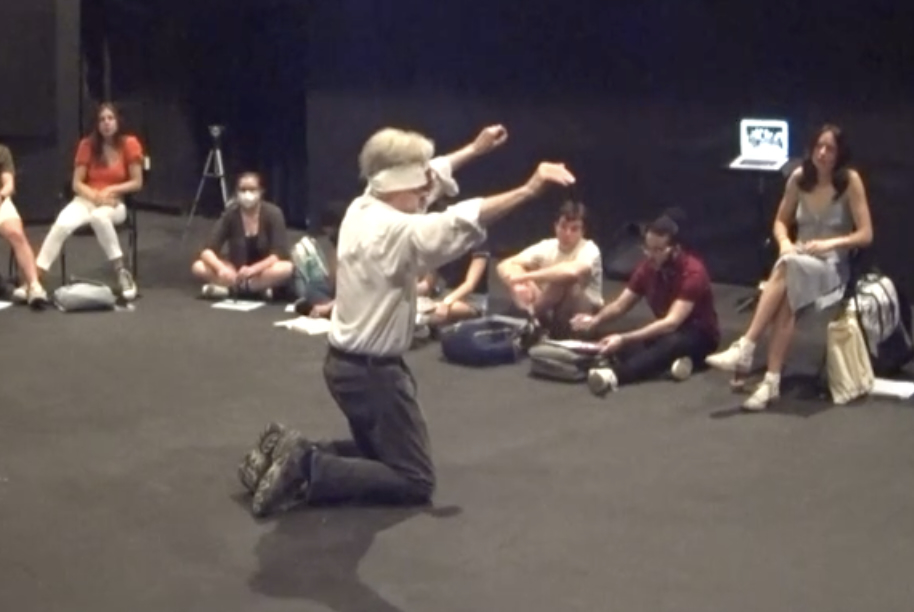
The actor playing Gloucester is of course blindfolded (the prop rag across his eyes, we can imagine, has been soaked in blood before he dons it). Thus, in the same way that the storm is literal in its soundscape, Gloucester's blindness is literal on stage. The character is blind; so also the actor. Neither character nor actor can see any of the things that are narrated throughout his journey. Is there any one else in the theater who is also unable to see those things which Gloucester cannot see? The answer, of course, is us. Edgar's narration and the entire fantasy trip to the cliffs of Dover can only be realized in the imagination: Gloucester's, the actor's, and ours. Our sympathies go out to Gloucester for his suffering, through the normal operations of empathic pain for his physical agony. A secondary awareness that the actor must be led, lest he walk off the stage, makes part of our concern for him more real to us. But the power of shared blindness works on us implicitly, and shadows every moment with an uncanny confusion. Our eyes are open, but they do not see.
This strange realism peaks with Edgar's famous descriptive speech:
The poetry of place is as rich here as in the lovely landscape descriptions that grace several plays. But where are these cliffs that Edgar so meticulously unfolds? The answer of course is nowhere. Their illusory, metaphorical presence is unreal across all the worlds. There's no cliff to be seen, anywhere, by any one either in the play or watching it. Our blindness is complete and completely literal.
But Gloucester does believe, just as he believes his guide is Poor Tom. Edgar teases him to the very edge, where Gloucester kneels, renounces the world, cries out "If Edgar live, oh, bless him!" And goes through with it. I invite you to try his leap, though I recommend a carpeted floor beneath you. Even though you are crumpling from a kneeling position, the landing is surprisingly hard. This comes across on stage, too. Like the actor shouting against the storm, the actor meets the physical situation with his body. The indifferent stage offers no comfort. Gloucester, both Earl and actor, lie inert for a few anxious seconds, during which Edgar speculates that he might have died after all, and we wonder if the actor has knocked himself out, but then stirs and shortly asks: "Have I fallen, or no?" The "I" here has doubled. The actor has fallen, possibly hard (a powerful performance option). To exactly the same extent, Gloucester has fallen. Edgar carries on the fiction of Gloucester's plummet, but it is floating in the imagination. What's on stage is what happened, in both the play world and the real one. As in our other examples, we can't exactly parse whether our experience is in the theater or on the heath.
Nature in King Lear is brutal. Characters in the play world suffer terribly, and without reason. Gloucester summarizes: "As flies to wanton boys are we to the gods: they kill us for their sport." The flat stage, in midafternoon, is the plain of that stormy remorseless world. It's literally tough on the principal actors, not fatal, but harsh enough that we must recognize the strain and pain, the sheer physical difficulty, of their parts. In that recognition we add a substrate of literal suffering to our already strong identification with these long-suffering old men.
In the pages ahead, we'll watch this ontological double-take redoubling across the plays. In some plays, like Macbeth, the double vision is very close to the central concern of the play, a vehicle for thematic impact. In others, the strategy seems to have been left aside, leaving the drama to unfold in ordinary spaces. Even in the examples in this introduction, I hope that the variety of doubletakes and their varying purposes and effects is plain. Their main effect is to intensify the realism of the drama, by means of actualizing, literally, features and dynamics of the play world. This serves to overcome the three barriers identified at the outset. We find ourselves experiencing the world through a character's eyes (or ears), but not solely by virtue of our emotional identification with the character. The double vision is the emotional afterburner. We experience the world from the standpoint of the other because the playwright has imported the other's world into our own, or perhaps it is as well expressed by saying the playwright has imported us into the world of the play.
Further notes 1_13_22:
One of the striking features of Shakespeare commentary is inherited from the plays themselves. In the plays, characters present much of the complexity and depth of actual persons. [Cavell's comment]. And the commentators refer to them as such, as real people caught in life's situations. In criticism, it's natural to reify characters and the fictive worlds they inhabit, but with WS reification is intoxicating. We spill over from Hamlet's professed motives to an entire world at Elsinore, beginning with a frigid dark night on the battlements. From there many will slide toward historical and geographical reality. So, Greenblatt will introduce us to the M of V with live standups in Venice. We learn all about the first ghetto, the migrations of Jews from various parts of Europe, the rules governing money-lending, among the postcard scenes of St. Mark's and the Rialto. Oh and by the way, Shakespeare was unaware of almost all of this, got the rest of it wrong, and indeed had never been to Venice.
Once in a while, the critic will step back in amazement that really the object of study is words, words, words. The Venice of Shakespeare does not exist and never did.
The other reification is of the author himself. This is a step up from the irreality of characters and worlds, since after all there was an actual author. In this vein, interpreters will labor to situate Shakespeare and his plays in the real city of London during a tempestuous time. Now the worries surround what he really wrote, which of the drafts that drifted into print were his ultimately intended words, and the chronology of his works. In this effort another kind of reification is at work, wherein we trace the author's development from the Marlovian bombast of Titus Andronicus to the supple mysteries of The Tempest. The plays are his autobiography. Thus we have Shakespeare the construct back-projected from the works we have, slim biographical records, and rich sources on Elizabethan and Jacobean England and the world. This is fascinating speculation to be sure – London in 1590 was weirdly like our contemporary world, but weirdly unlike it too. Overall, it was a brutal, dangerous, crowded place, a city in a world unused to cities. “Science” was a mix of Aristotelian first principles and seat-of-the-pants lore, and no one turned to science, technology, or government to improve one’s life. Instead, folks made their way under “Fortune,” whose arbitrary ups and downs on any day could be fatal. Against this backdrop it is astonishing, and lucky, that Shakespeare came to be, and that his works are with us still.
So our attention is grabbed in two directions: to the fictive worlds of Shakespeare's imagination, and to the murky world in which he lived. One can spend years studying either and yet still feel like something important is just out of reach.
What then is real? We might say, it's just the words. That's all. But that too is unsatisfying.
What’s real is us.
There’s the “us” that picks up the book, or enters the playhouse. But there’s a second us, which has been created by WS. Or rather, an array of us, created differently according to how the plays have shaped us.
This is not an idle or idolatrous claim (or not merely so). Rather, Shakespeare’s dramatis personae always includes an audience. Every commentator knows this, but our conception of art is bipolar. There’s the fictive world on stage, and the audience reaction to it. And that reaction is aesthetic, emotional, intellectual, appreciative, but above all passive. Reactive. We are all inclined to leave it at that, or perhaps talk of “reception”, which is what audiences do after they file out of the playhouse. My claim, however, is that we – the audience – engage in action as well as reaction. We participate in the action of the play, in as many ways as we can within the constraints of the real.
Moreover, the parts we play are not of our own improvising. That is, our part is written. By WS. And our parts are different in different plays. Each play is a specific inquiry into a possible role for you – at the edge of the stage.